Buying a furnace filter? Read the old frame first.
The size printed on your old filter’s cardboard frame tells you what to buy, and the arrow tells you which way it goes in. Get those right first. Then pick a MERV rating your system can handle.
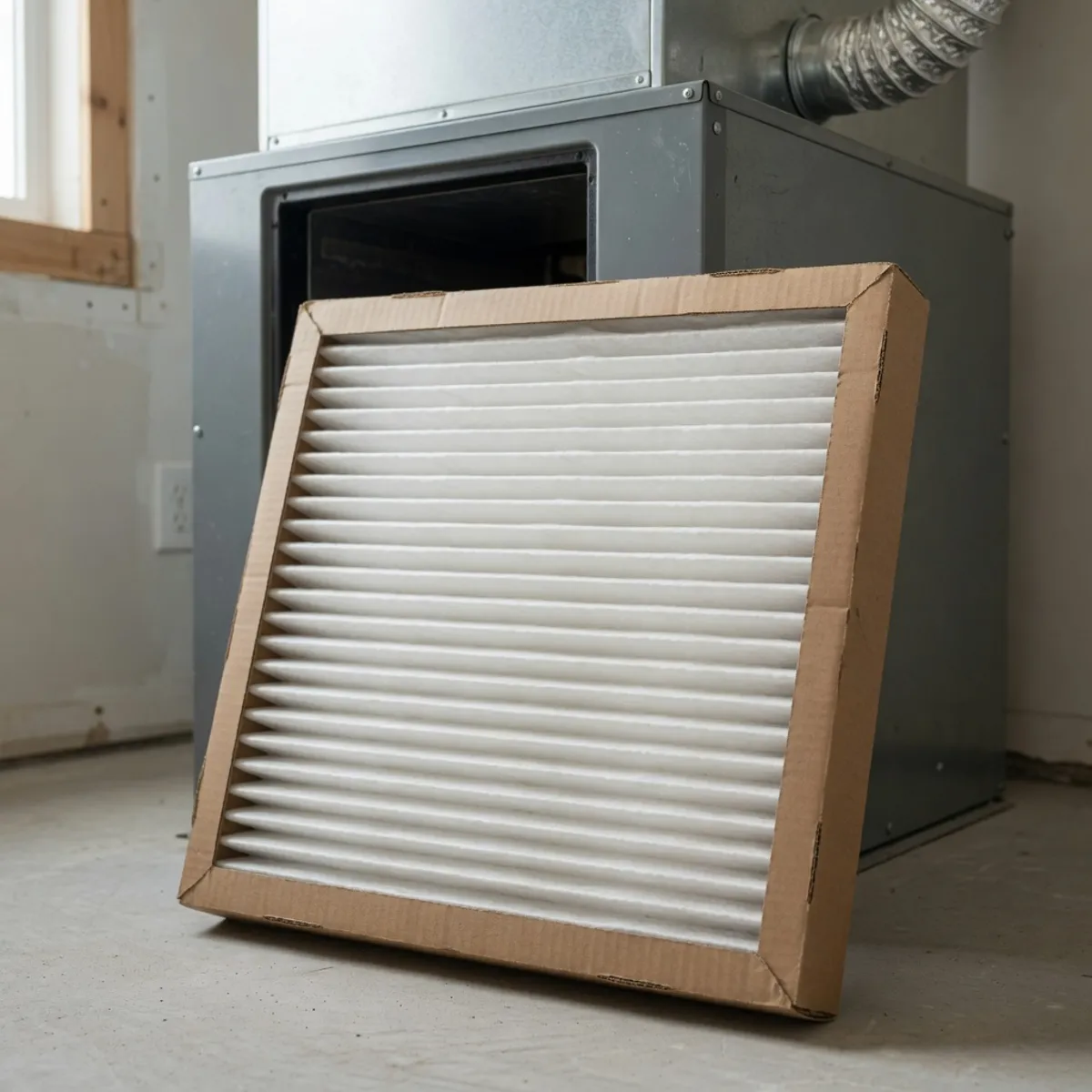
Our take: the easiest furnace-filter mistake to avoid is the wrong size. Copy the length, width and thickness printed on the old frame, then compare the replacement’s actual dimensions too, since one filter maker says a filter labeled 16x25x1 may really measure 15.5 × 24.5 × 0.75 inches. If you’re upgrading, EPA says to choose at least MERV 13, or as high as your system fan and filter slot can accommodate. If you’re jumping from a basic MERV 1 to MERV 13 or higher, DOE’s Building America Solution Center says to check with your HVAC service company first. After that, ENERGY STAR says to check the filter every month and change it at least every 3 months. [S5] [S7] [S1] [S3]
Same label, smaller panel
Copy the size before you shop
The Solution Center says the filter you’re replacing should have its length and width printed on the cardboard frame, and if it fits correctly, to buy one with the same dimensions. If it doesn’t fit correctly, measure the slot. A properly sized filter fits in the slot, completely covers the duct opening and lies flush with the frame, not crooked or diagonal. EPA adds that filters commonly come in thicknesses of 1 to 5 inches, and that the filter should fit snugly so air doesn’t leak around it, without bending or crushing it to make it fit. [S5] [S2]
- Find the filter. The Solution Center says all central furnaces and heat pumps have one, either in a slot between the return duct and the furnace cabinet or behind a large return grille in a ceiling, wall or floor. Some homes have more than one return grille, and each may hold a filter. [S5] [S8]
- Turn the system off at the thermostat before you pull the old filter, as both Solution Center guides say. [S5] [S8]
- Write down the three numbers printed on the frame, plus its MERV rating if one is printed. The return-grille guide says to note both. [S8]
- Measure the space too, including its depth. The Solution Center says the thickest filter the space can accommodate is ideal, because deeper pleats give the filter more surface area. [S5] [S8]
- Before you buy, compare the new filter’s actual dimensions, not just the nominal size. The Solution Center says to pay attention to both, and Nordic Pure’s sizing page says to verify actual dimensions whenever you switch brands. [S5] [S7]
Then pick a MERV your system can handle
EPA says a MERV (Minimum Efficiency Reporting Value) reports a filter’s ability to capture particles between 0.3 and 10 microns, using a test method developed by ASHRAE, and that the higher the MERV, the better the filter is at trapping specific sizes of particles. If you decide to upgrade, EPA says to choose at least MERV 13, or as high a rating as your system fan and filter slot can accommodate, and that you may need an HVAC technician to tell you what works best for your system. [S1] [S2]
| MERV | Smallest particle range EPA lists, with minimum average capture | What the Solution Center’s DIY guide says it catches |
|---|---|---|
| 1–4 | 3.0–10.0 µm: less than 20% [S1] | Large particles like lint, dust mites and pollen [S5] |
| 5–7 | 3.0–10.0 µm: at least 20% (MERV 5), 35% (MERV 6) or 50% (MERV 7) [S1] | Finer dust particles, pet dander and mold spores (MERV 5–8) [S5] |
| 8 | 1.0–3.0 µm: at least 20% [S1] | |
| 9–10 | 1.0–3.0 µm: at least 35% (MERV 9) or 50% (MERV 10) [S1] | Auto emissions, lead dust and larger bacteria (MERV 9–12) [S5] |
| 11–12 | 0.30–1.0 µm: at least 20% (MERV 11) or 35% (MERV 12) [S1] | |
| 13 | 0.30–1.0 µm: at least 50% [S1] | Very fine particles, including smoke, sneeze droplets and bacteria (MERV 13–16) [S5] |
| 14–16 | 0.30–1.0 µm: at least 75%, 85% or 95% [S1] |
EPA’s table also lists larger particle ranges for each rating; only the smallest range listed is shown here. Some packages use FPR or MPR instead of MERV. EPA says those two rating methods are proprietary while MERV is based on a national consensus standard, so we don’t convert between them. [S1] [S2]
A higher rating isn’t free. The Solution Center says higher-MERV filters can clog more quickly, restricting airflow, adding wear on the system and limiting its ability to heat and cool. Its high-MERV guide explains that excessive resistance to airflow can make some blower motors work harder or move less air, and in the worst case can lead to furnace overheating, frozen air-conditioner coils or burned-out blower motors. It also says a high MERV doesn’t automatically mean high resistance: deeper or more pleats lower it. [S5] [S6]
Choose your current filter to highlight its guidance.
Check with an HVAC pro before the big jump
The Solution Center says to check with your HVAC service company before switching from a MERV 1 to a MERV 13 or higher filter, to make sure it won’t hurt your system’s performance. For context, its high-MERV guide notes that ENERGY STAR requires filters of MERV 6 or higher, and DOE’s Zero Energy Ready Home and EPA’s Indoor AirPlus programs require MERV 8 or higher. Those are program requirements, not a rule for your house. [S5] [S6]
EPA’s upgrade target is MERV 13
EPA says most furnaces and HVAC systems can accommodate a MERV 13 filter without creating equipment problems, provided the filter is replaced frequently, but that systems aren’t commonly labeled with filter recommendations, so a technician is the way to be certain. The Solution Center’s high-MERV guide suggests matching the resistance to airflow on a return-grille label if your home has one, and choosing a filter that lists its static pressure on the package or online. [S2] [S6]
Keep the size, and watch how fast it loads
You’re already at or above EPA’s upgrade target. Because the Solution Center says higher-MERV filters can clog more quickly, the monthly check matters most here. If your slot can take a thicker filter, its DIY guide says the thickest filter the slot accommodates gives more surface area. [S1] [S5] [S3]
Clean it on schedule and dry it fully
The Solution Center says washable filters typically use electrostatic filtration, should be removed for cleaning every one to three months, rinsed, air dried and reinstalled, and can harbor mold if they aren’t dried properly. Its return-grille guide says to follow the manufacturer’s cleaning instructions and let the filter dry completely before reinstalling. None of our sources give a MERV for washable filters, so check the label. [S6] [S8]
Copy the old one, or ask
EPA notes that HVAC systems aren’t commonly labeled with filter recommendations. When no resistance information is available, the Solution Center’s high-MERV guide suggests buying the same or a similar model as the spent filter, using the dimensions you wrote down, and looking for a MERV 6 or higher filter that lists its static pressure. A technician can tell you the most efficient filter your system can use. [S2] [S6]
These branches summarize agency, national-lab and manufacturer guidance. They are not an HVAC inspection of your system.
Check it monthly, change it when it’s dirty
ENERGY STAR says to check your filter every month, especially during heavy-use months in winter and summer, to change it if it looks dirty after a month, and at a minimum to change it every 3 months. It says a dirty filter slows airflow and makes the system work harder, and its maintenance checklist adds that a dirty filter can increase energy costs and damage your equipment. [S3] [S4]
Enter the number of days to compare it with the published intervals.
The day check only compares your number with published intervals. It can’t see how dirty your filter is, and nothing you type is saved or sent.
Where the sources pull in different directions
How long a filter lasts. ENERGY STAR says check monthly and change at least every 3 months. EPA says manufacturers typically recommend replacement every 60 to 90 days and to change more often if filters look heavily soiled. The Solution Center’s high-MERV guide says every three months or sooner, while its two DIY guides say every 3 to 6 months. We’d check monthly, follow the filter maker’s interval, and treat 3 months as the outer limit unless the maker says otherwise. A dirty filter is the signal every source agrees on. [S3] [S2] [S6] [S5]
How high a MERV. EPA names MERV 13 as the upgrade target and says most systems can take it if the filter is changed often. The Solution Center says to check with your HVAC service company before jumping from MERV 1 to MERV 13 or higher, and explains how resistance can strain equipment. Both say a technician can settle it for your system. [S1] [S2] [S5] [S6]
How tight a fit. Nordic Pure says to choose a filter slightly smaller than a measured opening. EPA says the filter should fit snugly so air doesn’t leak around it, and the Solution Center suggests foam weatherstripping tape around the frame if a filter is quite loose. A filter a little under the slot size, sealed with foam tape if it’s loose, satisfies all three. [S7] [S2] [S5]
Point the arrow toward the furnace
The Solution Center says to remove any plastic wrap but not the cardboard frame, and to write the installation date on the visible side of the frame so you know when it was last changed. The airflow arrows on the frame should point into the duct, toward the furnace or air handler. Its high-MERV guide adds that in an upflow air handler, that means the arrow points up, even if the writing ends up upside down. [S5] [S6]
Then close up. The Solution Center says to reinstall the slot cover so it fits tightly to limit air leakage, but not to tape or caulk it shut, since you’ll be changing the filter again. It also warns that the metal wire over some filter fabric can be very sharp. ENERGY STAR suggests a contractor check-up of the heating system each fall, and says your contractor can show you how to change the filter. [S5] [S4]
Before you put the cover back
Before you buy a pack of filters
Is a higher MERV always better?
Better at catching small particles, yes, per EPA. But the Solution Center says higher-MERV filters can clog faster and restrict airflow, and that the right choice depends on what your system can handle. Deeper pleats can lower resistance at the same rating. [S1] [S5] [S6]
The package says MPR or FPR, not MERV. Which is which?
EPA says MERV, FPR and MPR are all commonly used, that FPR and MPR are proprietary while MERV is based on a national consensus standard, and that for every method a higher number means higher removal for most particle sizes. EPA gives no conversion between them, and neither do we. Look for a MERV on the package if you want to compare across brands. [S2]
My old filter is 1 inch. Can I buy a 4-inch one?
Only if the slot has room. The Solution Center shows a slot built to take either a 1-inch or a 4-inch filter and says the thicker one would be better there, because deeper pleats mean more surface area. Measure the depth of the space first; EPA says don’t bend or crush a filter to make it fit. [S5] [S2]
Will a better filter fix a musty smell?
No. EPA says furnace and HVAC filters don’t address the cause of mold and musty odors, which is a water or moisture problem. Fix the moisture source and clean up the mold. [S2]
Should I run the furnace fan all the time to filter more air?
EPA says furnace filters only work while the system runs, usually less than 25% of the time in heating and cooling seasons, and that longer run times raise electricity costs and may weaken humidity control in the cooling season. EPA says that may not be desirable or practical in many cases, so we don’t recommend it either way. [S2]
Does EPA recommend a brand?
No. EPA says it does not certify or recommend specific brands or models of air filters. We don’t rank them here either. [S2]
Sources
EPA, ENERGY STAR, DOE’s Building America Solution Center and one filter maker’s sizing page, checked October 15, 2026. Recommendations here are editorial interpretation of that guidance; no hands-on results are claimed.
- S1 · EPA: What is a MERV rating?
- S2 · EPA: Guide to Air Cleaners in the Home (2nd edition, 2018, PDF)
- S3 · ENERGY STAR: Heat & Cool Efficiently
- S4 · ENERGY STAR: Maintenance checklist
- S5 · DOE Building America Solution Center (PNNL): Replace air filter located in furnace or central heat pump air filter slot
- S6 · DOE Building America Solution Center (PNNL): High-MERV filters
- S7 · Nordic Pure: How to measure (filter maker sizing page)
- S8 · DOE Building America Solution Center (PNNL): Replace air filter located at return air filter grille