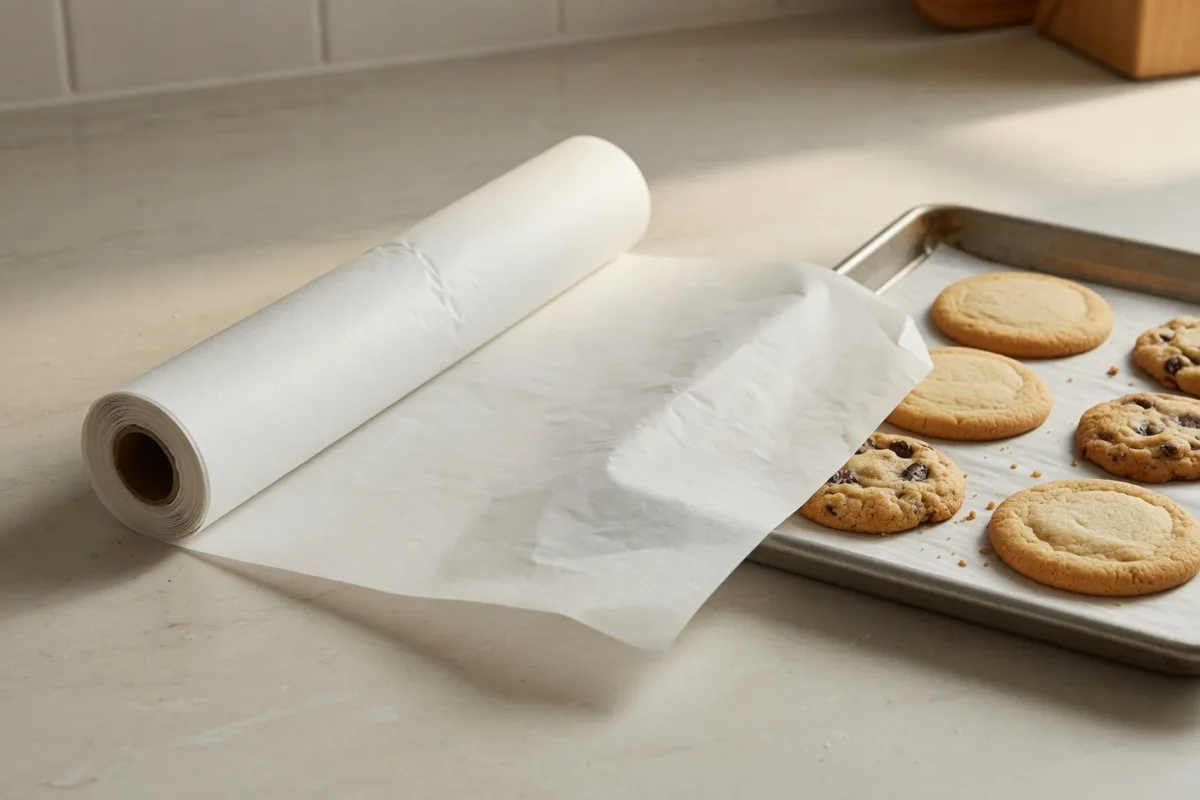
Two nonstick papers. Different heat rules.
For an ordinary tray of cookies, reach for baking parchment that is approved for your oven and recipe temperature. Wax paper is useful at the counter, but it is not an interchangeable cookie-sheet liner. The gap between the cookies matters: that paper remains exposed to oven heat. Reynolds’ baking instructions
This guide compares the instructions for Reynolds Kitchens Parchment Paper With Stay Flat Dispensing (SmartGrid) and Reynolds Kitchens Cut-Rite Wax Paper. It does not rank the brands, verify an Amazon listing or transfer these directions to every roll called “baking paper.” Keep the actual box.
Parchment paper
Paper with a nonstick, heat-resistant coating.
Wax paper
Paper coated with food-grade wax.
Similar-looking rolls can invite an automatic swap. A better habit is to match the material to the next step in the recipe, not simply to the job of preventing sticking. “Nonstick” describes a useful feature; it does not name the appliance or cooking mode the paper can handle.
Compare the task, not the roll.
| Task | Parchment | Cut-Rite wax |
|---|---|---|
| Spaced cookies in a conventional oven | Within its oven directions | Do not substitute |
| Rolling dough at the counter | Useful nonstick surface | Manufacturer-listed use |
| Microwave cover | Follow product directions | Manufacturer-listed use |
| Broiling | Do not use | Do not use |
Source: Reynolds’ task comparison and Cut-Rite instructions. The fully covered cake-pan exception is explained below. A short “yes/no” chart cannot carry every condition on its own.
Separate microwave permission from oven permission. A microwave-safe paper is not automatically suitable for convection, grill or combination modes on the same appliance. If your machine has several modes, check the mode you are actually selecting and the appliance manual.
Read beyond the temperature.
Reynolds rates the named parchment for conventional ovens up to 425°F. Preheat first. Keep it away from open flame and oven surfaces. Reynolds specifically excludes broilers and toaster ovens; a lower dial setting does not erase that restriction. Parchment product FAQ
For cookie sheets, Reynolds advises keeping parchment edges from hanging over the pan. Fit the sheet before adding food. Do not interpret a temperature rating as permission to drape paper against an oven wall, rack or heating area. Baking and pan-lining directions
Air fryers are outside this comparison. A roll, a perforated sheet and a dedicated liner are not the same product. Use the exact liner’s directions together with the appliance manual rather than carrying the conventional-oven rule into a different device.
If a recipe asks for a hotter oven than the paper permits, do not quietly increase the paper’s limit. Choose a method and material approved for the required conditions. The paper should fit the recipe and equipment, not become an experiment halfway through cooking.
Why a cake-pan exception is not a cookie rule.
Cut-Rite’s manufacturer permits it as a pan liner for cakes, bread, muffins and similar baking only when dough or batter completely covers the wax-paper lining. It also says the paper should not be directly exposed to oven heat. Those two instructions belong together. Cut-Rite oven-use FAQ
A few dough rounds on a sheet do not create that condition. Nor does putting paper in a pan automatically make it covered. If you cannot confidently match the manufacturer’s specific exception, use a recipe-compatible lining method with clear instructions instead of guessing.
Find the instruction you need.
Select your task for a reminder of the relevant boundary. This tool identifies which instructions to consult; it does not certify a recipe, appliance or unidentified paper.
Make the next use easier.
- Keep the identity. Store the roll with its box or retain the product name and directions. A loose sheet is a poor place to start a compatibility decision.
- Keep the instructions together. Read the recipe, paper package and appliance manual before lining the pan. Resolve a mismatch before food goes into the appliance.
- Reconsider reuse. A nonstick sheet is not automatically suitable for another job. King Arthur cautions against reusing parchment that held meat or fish, or that has sticky residue that cannot be readily cleaned. Parchment reuse guidance
At the counter, Cut-Rite’s listed jobs include rolling dough between sheets and catching frosting or sprinkles. That is useful on its own. There is no need to turn every roll into an all-purpose oven liner. Manufacturer prep uses
Does paper color tell me which one I have?
Use the packaging and product identity, not an appearance-based guess. This comparison does not provide a color, shine or touch test for unidentified paper.
Does “Stay Flat” change the heat rating?
Stay Flat describes the dispensing package; SmartGrid supplies cutting and spacing guides. Read the separate cooking directions for the permitted use. Product features and FAQ
Can I use wax paper as a microwave cover?
Reynolds lists that use for Cut-Rite. Follow the exact paper and microwave instructions; this permission does not cover other heating modes. Cut-Rite microwave FAQ
Sources & scope
Manufacturer instructions checked October 11, 2026 California time (October 12 UTC). No hands-on testing or retail offer checks.